| Each of these articles provides a remarkable description of an unforgettable event among some of the most exciting animals in the world! |
Wildlife Adventures
Enjoy two more articles FREE here
at WildlifeAdventures.biz
at WildlifeAdventures.biz

Rainforest Parrot Kingdom

 |
| |
 |
| |
 |
| |
 |
| |
 |
| |
 |
| |
 |
| |
 |
| |
 |
| |
 |
| |
 |
| |
 |
| |
 |
| |
 |
We hope you have enjoyed this story of an extraordinary day in the field
with Paul.
You can order as many as 30 Wildlife Adventures articles from this web
site – individually – or all 30 on a CD with 30 corresponding photos.
Check out the entire list of titles right away on our Home Page.
Each CD containing all 30 articles with 30 photos is just $10 (plus a
small shipping fee). That's a huge savings, even if the individual articles
are so economically priced.
Buy one or more CDs today! Email Trust@WildlifeAdventures.biz
Continue to enjoy Wildlife Adventures!
Now enjoy the second FREE story – Close Call in Africa:
with Paul.
You can order as many as 30 Wildlife Adventures articles from this web
site – individually – or all 30 on a CD with 30 corresponding photos.
Check out the entire list of titles right away on our Home Page.
Each CD containing all 30 articles with 30 photos is just $10 (plus a
small shipping fee). That's a huge savings, even if the individual articles
are so economically priced.
Buy one or more CDs today! Email Trust@WildlifeAdventures.biz
Continue to enjoy Wildlife Adventures!
Now enjoy the second FREE story – Close Call in Africa:
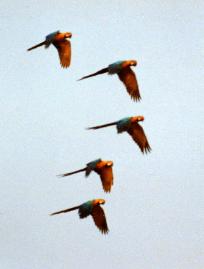
As the first flock of 10 big Scarlet Macaws burst over the rainforest
canopy they collectively voiced their loud jungle calls. Their flight
pierced the pink morning sky along a remote Amazon River tributary in
southeast Peru. With slow, stately wingbeats the colorful, long-tailed
macaws crossed the Tambopata River, followed by flocks of smaller Blue-
headed Parrots that winged quickly past, adding their high-pitched calls
to the growing morning chorus. During the next hour, an enduring
parade of macaws and parrots assembled, building minute by minute. It
was an amazing avian spectacle!
The macaws and other parrots formed loud mixed-species flocks in the
tall trees at the edge of the rainforest, ever building in numbers and
diversity along a steep clay cliff eroded by the rushing river. Big macaws
continued to fly over the area, mostly Blue-and-Yellow Macaws, Red-and-
Green Macaws, and Scarlet Macaws. The largest flocks of all were
composed of the mini-parrots, the little Dusky-billed Parrotlets that called
incessantly as they winged swiftly overhead.
I identified 13 species of parrots that morning, including five species of
macaws. I estimated that a total of about 120 big macaws gathered here,
along with more than 300 other parrots, although more than twice that
number have been recorded at the Tambopata clay lick during peak
periods. In many locations in Latin America, it is a treat to see one macaw
or a single flock of parrots – this was an amazing opportunity in a
remarkable rainforest location.
Why does this site attract so many parrots? The far bank of the river is a
tall, exposed clay cliff. Ornithologists studying the behavior of macaws
believe the birds are attracted by the clay, which they eat to obtain
required salts, nutrients and trace minerals absent from their vegetarian
diet. The clay also is required to neutralize semi-toxic chemicals
contained in some of the seeds they eat. Undoubtedly, the clay lick also
acts as an important social arena where birds can meet and interact.
Most parrots and macaws are, after all, very social birds.
Soon, a big flock of Blue-headed Parrots began flying back and forth
across the bare clay slope with an almost frenzied determination. As they
landed en masse on a prominent clay ridge, individual birds immediately
began chipping away pieces of sun-baked clay with their strong beaks to
eat it. Pairs of Yellow-crowned and Mealy Parrots joined them, and small
flocks of Chestnut-fronted Macaws also mixed in.
A few big macaws joined the parrots, and eventually about 30 Blue-and-
Yellow Macaws dominated the scene, along with half as many Scarlets
and one pair of Red-and-Green Macaws. The scene was as exhilarating
as any natural spectacle I have witnessed, all with the backdrop of the
Amazon rainforest along a wild jungle river at sunrise.
In retrospect, this grand parrot scene must be counted as one of the
greatest natural spectacles on earth! This is especially true when you
consider that this area boasts the most diversity of birds of anywhere in
the world. In this region, where the Amazon River Basin meets the Andes
Mountains, no less than 560 different species of birds have been
recorded in a single square mile of rainforest! This includes a number of
kinds of such exciting birds as toucans, tanagers, eagles, hummingbirds,
woodpeckers, barbets, manakins, tinamous, and many more.
Mammals are harder to find, but among the possibilities are such
exciting animals as jaguars, ocelots, tapirs, giant river otters, and more
than a dozen varieties of monkeys. As you ride this wild river in a jungle
canoe, any turn in the route can offer a never-to-be-forgotten sighting.
The towering beauty of the verdant rainforest harbors all these animals
and more, but it is the rainforest itself, with infinite shades of green, that
captures visitors’ imagination. A visit to a wildlife-rich tropical forest is
an event to be savored and repeated time and time again.
canopy they collectively voiced their loud jungle calls. Their flight
pierced the pink morning sky along a remote Amazon River tributary in
southeast Peru. With slow, stately wingbeats the colorful, long-tailed
macaws crossed the Tambopata River, followed by flocks of smaller Blue-
headed Parrots that winged quickly past, adding their high-pitched calls
to the growing morning chorus. During the next hour, an enduring
parade of macaws and parrots assembled, building minute by minute. It
was an amazing avian spectacle!
The macaws and other parrots formed loud mixed-species flocks in the
tall trees at the edge of the rainforest, ever building in numbers and
diversity along a steep clay cliff eroded by the rushing river. Big macaws
continued to fly over the area, mostly Blue-and-Yellow Macaws, Red-and-
Green Macaws, and Scarlet Macaws. The largest flocks of all were
composed of the mini-parrots, the little Dusky-billed Parrotlets that called
incessantly as they winged swiftly overhead.
I identified 13 species of parrots that morning, including five species of
macaws. I estimated that a total of about 120 big macaws gathered here,
along with more than 300 other parrots, although more than twice that
number have been recorded at the Tambopata clay lick during peak
periods. In many locations in Latin America, it is a treat to see one macaw
or a single flock of parrots – this was an amazing opportunity in a
remarkable rainforest location.
Why does this site attract so many parrots? The far bank of the river is a
tall, exposed clay cliff. Ornithologists studying the behavior of macaws
believe the birds are attracted by the clay, which they eat to obtain
required salts, nutrients and trace minerals absent from their vegetarian
diet. The clay also is required to neutralize semi-toxic chemicals
contained in some of the seeds they eat. Undoubtedly, the clay lick also
acts as an important social arena where birds can meet and interact.
Most parrots and macaws are, after all, very social birds.
Soon, a big flock of Blue-headed Parrots began flying back and forth
across the bare clay slope with an almost frenzied determination. As they
landed en masse on a prominent clay ridge, individual birds immediately
began chipping away pieces of sun-baked clay with their strong beaks to
eat it. Pairs of Yellow-crowned and Mealy Parrots joined them, and small
flocks of Chestnut-fronted Macaws also mixed in.
A few big macaws joined the parrots, and eventually about 30 Blue-and-
Yellow Macaws dominated the scene, along with half as many Scarlets
and one pair of Red-and-Green Macaws. The scene was as exhilarating
as any natural spectacle I have witnessed, all with the backdrop of the
Amazon rainforest along a wild jungle river at sunrise.
In retrospect, this grand parrot scene must be counted as one of the
greatest natural spectacles on earth! This is especially true when you
consider that this area boasts the most diversity of birds of anywhere in
the world. In this region, where the Amazon River Basin meets the Andes
Mountains, no less than 560 different species of birds have been
recorded in a single square mile of rainforest! This includes a number of
kinds of such exciting birds as toucans, tanagers, eagles, hummingbirds,
woodpeckers, barbets, manakins, tinamous, and many more.
Mammals are harder to find, but among the possibilities are such
exciting animals as jaguars, ocelots, tapirs, giant river otters, and more
than a dozen varieties of monkeys. As you ride this wild river in a jungle
canoe, any turn in the route can offer a never-to-be-forgotten sighting.
The towering beauty of the verdant rainforest harbors all these animals
and more, but it is the rainforest itself, with infinite shades of green, that
captures visitors’ imagination. A visit to a wildlife-rich tropical forest is
an event to be savored and repeated time and time again.
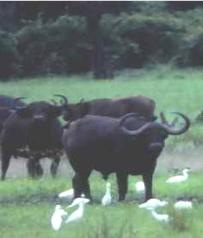
Suddenly, from the tall green grass just a few steps before me, as if
rising up from the ground itself, a massive black rock-like image raised
up with long, sharp, upturned horns. The big black mass continued to
rise slowly to reveal the face, muzzle and drooping ears of a giant bull
Cape buffalo. It stood tall with a thick neck, broad shoulders and humped
back. Its huge body measured a good 12 feet long. As the giant buffalo
faced me eye to eye, with its broad horns stretching five feet across, it
seemed as if time stood still.
I did not breathe, but I could hear my heart pumping loudly within my
chest – or was that the buffalo’s beating heart? I dared to move only my
eyes to one side, then the other, to verify what I already knew – there
were no trees within life’s reach. My knees began to tremble
uncontrollably, followed by the rest of my legs. What now? I had no
options to evade this hairy freight train. I had run out of luck.
I almost resigned myself to the whims of the buffalo, when the monster
suddenly broke the stalemate. It twisted its horns and head around in a
rapid turn of direction and quickly ran, quartering away from me. The
ground honestly shook as the half-ton black bovine thundered away. I
quickly regained my composure, wiped the sweat from my forehead and
started to breathe again, first in long deep breaths, then in normal
cadence. “Geez, that was close!” I thought as I took a couple feeble steps
to the left on my still wobbly legs.
Then reality checked back in – there were two buffalo! Even before I
could stop in my tracks, another huge mass of black buffalo monster
raised from the grass in front of me. No less horrible, no less imposing, it
raised up in déjà vu fashion. Again, I stared into the eyes of a half-ton of
wild animal that showed no sense of remorse for scaring the hell out of
me. I knew there was nowhere to hide, nowhere to run. This was another
showdown. The only move I would make was to stop breathing – and
hope my heart kept beating. I could hear my heart; I could feel it; yet time
seemingly ceased to pass for moments until the broad black horns swung
around as the twin monster ran off, the ground shaking beneath his four
huge hooves.
Whew. No mas. No more buffalo hiding in the grass. I didn’t test my luck
further along this ridge. After all, there could have been a pride of lions
sneaking in on the buffalo when I roused them; or they may have scared
a cobra or adder my way as they ran off. It was time to play it a little safer
– make that a lot safer – and walk back to the haven of the lodge.
Old buffalo bulls are known for their tempers and they have killed their
share of humans. The old bulls leave the herds, where they live for years
with hundreds of other buffs, to live alone or in duos. On their own, they
are more scared, more temperamental, meaner and more likely to trample
you. I was fully aware of the danger of this pair of old lone bulls, and
when I noticed them in the area I made it a point to alert the other people
staying at the lodge not to walk around the area, for the ole bulls were
dangerous and not to be trusted. (I’ve always been better at giving
advice than following it.)
The massive Cape buffalo bulls, however, are not the only dangers
hiding in the grass. Africa is still a wild place and parts of southern Africa
still endure as wild as ever with amazing populations of animals. I lived in
southern Africa for five months, working as a wildlife biologist in the
remote reaches of the Zambezi and Congo Rivers. During my studies, I
endured close calls with a rhino, a spitting cobra, and killer bees in
addition to the big buffs that bluffed (or did they?). There were also lions
and hippos and crocodiles to contend with, but it was the mosquitoes
and tsetse flies that really scared me, for they can transmit terrible
diseases without alarm. Then too, if I was afraid of all the potential
hazards in Africa and elsewhere, I would have stayed at home. But that’s
far from likely . . .
rising up from the ground itself, a massive black rock-like image raised
up with long, sharp, upturned horns. The big black mass continued to
rise slowly to reveal the face, muzzle and drooping ears of a giant bull
Cape buffalo. It stood tall with a thick neck, broad shoulders and humped
back. Its huge body measured a good 12 feet long. As the giant buffalo
faced me eye to eye, with its broad horns stretching five feet across, it
seemed as if time stood still.
I did not breathe, but I could hear my heart pumping loudly within my
chest – or was that the buffalo’s beating heart? I dared to move only my
eyes to one side, then the other, to verify what I already knew – there
were no trees within life’s reach. My knees began to tremble
uncontrollably, followed by the rest of my legs. What now? I had no
options to evade this hairy freight train. I had run out of luck.
I almost resigned myself to the whims of the buffalo, when the monster
suddenly broke the stalemate. It twisted its horns and head around in a
rapid turn of direction and quickly ran, quartering away from me. The
ground honestly shook as the half-ton black bovine thundered away. I
quickly regained my composure, wiped the sweat from my forehead and
started to breathe again, first in long deep breaths, then in normal
cadence. “Geez, that was close!” I thought as I took a couple feeble steps
to the left on my still wobbly legs.
Then reality checked back in – there were two buffalo! Even before I
could stop in my tracks, another huge mass of black buffalo monster
raised from the grass in front of me. No less horrible, no less imposing, it
raised up in déjà vu fashion. Again, I stared into the eyes of a half-ton of
wild animal that showed no sense of remorse for scaring the hell out of
me. I knew there was nowhere to hide, nowhere to run. This was another
showdown. The only move I would make was to stop breathing – and
hope my heart kept beating. I could hear my heart; I could feel it; yet time
seemingly ceased to pass for moments until the broad black horns swung
around as the twin monster ran off, the ground shaking beneath his four
huge hooves.
Whew. No mas. No more buffalo hiding in the grass. I didn’t test my luck
further along this ridge. After all, there could have been a pride of lions
sneaking in on the buffalo when I roused them; or they may have scared
a cobra or adder my way as they ran off. It was time to play it a little safer
– make that a lot safer – and walk back to the haven of the lodge.
Old buffalo bulls are known for their tempers and they have killed their
share of humans. The old bulls leave the herds, where they live for years
with hundreds of other buffs, to live alone or in duos. On their own, they
are more scared, more temperamental, meaner and more likely to trample
you. I was fully aware of the danger of this pair of old lone bulls, and
when I noticed them in the area I made it a point to alert the other people
staying at the lodge not to walk around the area, for the ole bulls were
dangerous and not to be trusted. (I’ve always been better at giving
advice than following it.)
The massive Cape buffalo bulls, however, are not the only dangers
hiding in the grass. Africa is still a wild place and parts of southern Africa
still endure as wild as ever with amazing populations of animals. I lived in
southern Africa for five months, working as a wildlife biologist in the
remote reaches of the Zambezi and Congo Rivers. During my studies, I
endured close calls with a rhino, a spitting cobra, and killer bees in
addition to the big buffs that bluffed (or did they?). There were also lions
and hippos and crocodiles to contend with, but it was the mosquitoes
and tsetse flies that really scared me, for they can transmit terrible
diseases without alarm. Then too, if I was afraid of all the potential
hazards in Africa and elsewhere, I would have stayed at home. But that’s
far from likely . . .
Close Call in Africa
We hope you have enjoyed this story of an extraordinary day in
the field with Paul and the golden grizzly. Now you have an
opportunity to enjoy even more exploits – across America and
around the world:
You can order as many as 30 Wildlife Adventures articles from
this web site, individually, or all 30 on a CD with 30 corresponding
photos.
Check out the entire list of titles right away on our Home Page.
Each CD containing all 30 articles with 30 photos is just $10
(plus a small shipping fee). That's a huge savings, even if the
individual articles are so economically priced.
Buy one or more CDs today!
Contact us by
Email Trust@WildlifeAdventures.biz
Telephone 714 - 916 - 4397
Enjoy Wildlife Adventures to the MAX!
the field with Paul and the golden grizzly. Now you have an
opportunity to enjoy even more exploits – across America and
around the world:
You can order as many as 30 Wildlife Adventures articles from
this web site, individually, or all 30 on a CD with 30 corresponding
photos.
Check out the entire list of titles right away on our Home Page.
Each CD containing all 30 articles with 30 photos is just $10
(plus a small shipping fee). That's a huge savings, even if the
individual articles are so economically priced.
Buy one or more CDs today!
Contact us by
Email Trust@WildlifeAdventures.biz
Telephone 714 - 916 - 4397
Enjoy Wildlife Adventures to the MAX!
| Please also check out our other articles by buying a Wildlife Adventures CD today. Thanks for joining us at Wildlife Adventures .biz |
|
| |
|
| |
|
| |
|
| |
|
| |
|
| |
|
| |
|
| |
|
| |
|
| |
|
| |
|
| |
|
| |
|
Blue-and-Yellow Macaws
South America
South America
Cape Buffalo
Africa
Africa